ISO 9001:2026 Transition Consulting
ISO 9001:2026 is published. Organizations certified to ISO 9001:2015 now have a clear path—and a firm deadline—to move to the new edition. Paradygm Consulting helps companies in Canada and the United States plan, implement, and complete their ISO 9001:2026 transition with fixed-cost consulting and guaranteed certification support (subject to agreed scope and client cooperation).
Whether you need a focused gap analysis, documentation updates, staff training, or full transition support through your certification body’s audit, our team has guided organizations through ISO-based certifications for 25+ years.
Call 1-855-702-9001 · Email info@paradygm.co · Offices in Thornhill, Ontario and Coral Springs, Florida
What is ISO 9001:2026?
ISO 9001:2026 is the current edition of the world’s most widely used quality management system (QMS) standard. Published by the International Organization for Standardization (ISO) on 16 September 2026, it replaces ISO 9001:2015 (including the climate change amendment published in 2024).
ISO describes the revision as a targeted evolution—not a rewrite. Customer focus, the process approach, risk-based thinking, and continual improvement remain at the core. The new edition strengthens leadership, quality culture, and clarity around risks and opportunities, and it adopts the latest Harmonized Structure used across ISO management system standards—making it easier to run an integrated management system (IMS) with ISO 14001, ISO 45001, and related standards.
For organizations already certified to ISO 9001:2015, that means you do not start from scratch. You build on what works and close the gaps that matter.
What’s changing in ISO 9001:2026
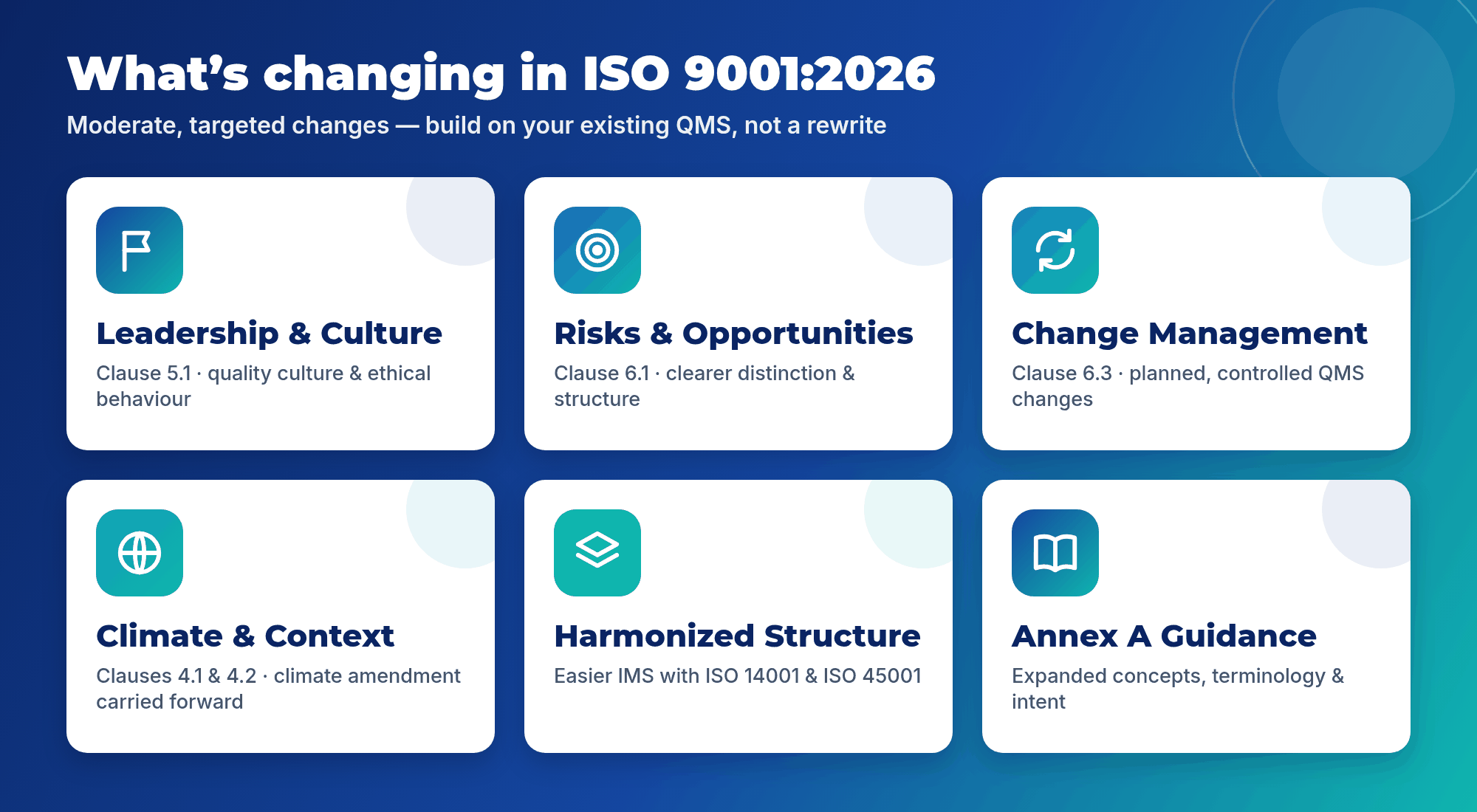
The six key change themes in ISO 9001:2026. Changes are moderate and build on your existing QMS.
Based on ISO’s published guidance and registrar summaries of the approved text, the main themes of change include:
Confirmed themes (published edition)
Stronger leadership, quality culture, and ethical behaviour
Top management accountability is reinforced. Quality culture and ethical behaviour are explicitly tied to leadership commitment and awareness expectations (Clause 5.1 and related clauses).Closer alignment with business strategy
The quality policy is more clearly linked to the organization’s context and strategic direction, so the QMS supports business objectives—not just compliance.Clearer treatment of risks and opportunities
Risks and opportunities are more clearly distinguished, with clearer structure under Clause 6.1 and expanded guidance in Annex A.Reinforced management of change
Requirements related to planning and managing changes to the QMS are strengthened (Clause 6.3), so changes are controlled in a way that supports intended results.Greater emphasis on people and awareness
Awareness expectations recognize that quality depends on people’s understanding of quality culture and ethical behaviour—not only on documented processes.Expanded Annex A guidance
A substantially expanded Annex A clarifies key concepts, terminology, and the intent behind requirements—improving consistency of interpretation.Climate change considerations carried forward
Climate-related considerations introduced via ISO 9001:2015/Amd 1:2024 are now integrated into the 2026 edition (Clauses 4.1 and 4.2).Harmonized Structure alignment
The standard aligns with the latest Harmonized Structure for ISO management system standards, which simplifies multi-standard (IMS) implementations.Modern operating realities reflected in guidance
ISO and registrars note refinements that reflect digitalization, organizational knowledge, complex supply chains, and resilience. The standard does not mandate artificial intelligence or specific digital tools; where technology is used, organizations still need reliable information, clear decision accountability, and controlled documented information.
Overall assessment from major registrars: changes are generally described as moderate—less extensive than the jump to the 2015 edition.
Transition timeline (accredited certification)
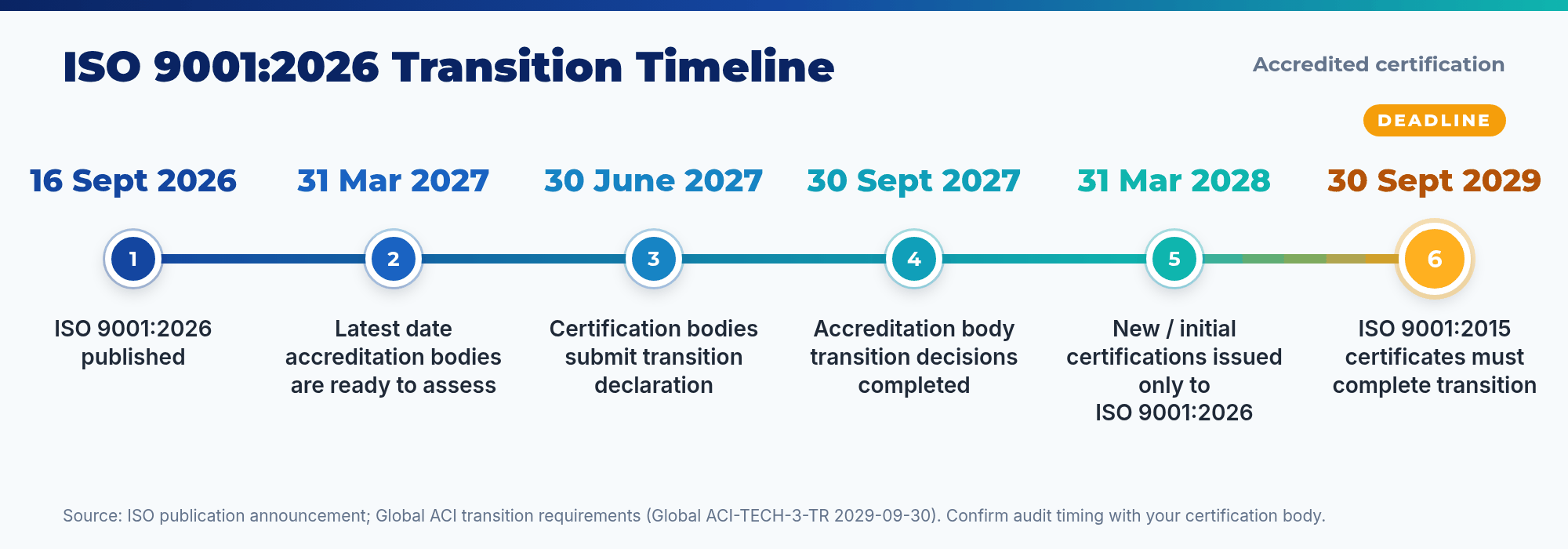
ISO 9001:2026 transition milestones per Global ACI. Confirm audit timing with your certification body.
Global Accreditation Cooperation Incorporated (Global ACI) has published mandatory transition requirements for ISO 9001:2026 (Global ACI-TECH-3-TR 2029-09-30). Key dates for organizations and their accredited certification bodies:
ISO 9001:2026 published — 16 September 2026
Accreditation bodies ready to assess against ISO 9001:2026 — No later than 31 March 2027
Certification bodies submit transition declaration — By 30 June 2027
Accreditation body transition decisions completed — By 30 September 2027
New / initial accredited certifications issued only to ISO 9001:2026 — From 31 March 2028
Organizations certified to ISO 9001:2015 must complete transition — By 30 September 2029
Transition audits may take place during a scheduled surveillance or recertification audit, or as a separate transition audit—coordinate timing with your certification body.
Practical takeaway: you have until 30 September 2029 if you already hold an accredited ISO 9001:2015 certificate—but waiting until the last year creates schedule risk with auditors, trainers, and internal resources. Organizations seeking new certification should plan for ISO 9001:2026 as the default path once the March 2028 cutoff approaches.
Who needs to act
You should plan an ISO 9001:2026 transition if you are:
Currently certified to ISO 9001:2015 (or 2015 plus the 2024 climate amendment) and want to keep an accredited certificate valid past September 2029
Seeking first-time certification and want to certify to the current edition from the start
Running a multi-site or multi-country QMS (Canada, US, or both) where documentation, training, and audit scheduling need early alignment
Operating an integrated management system (ISO 9001 + ISO 14001 and/or ISO 45001, AS9100 family, or R2) and want one coordinated gap analysis and rollout
Supplying customers who will soon require evidence of transition planning or ISO 9001:2026 certification on supplier questionnaires and contracts
Aerospace, electronics, manufacturing, recycling, or regulated suppliers where quality culture, change control, and supply-chain expectations are already under customer scrutiny
Recommended ISO 9001:2026 transition steps
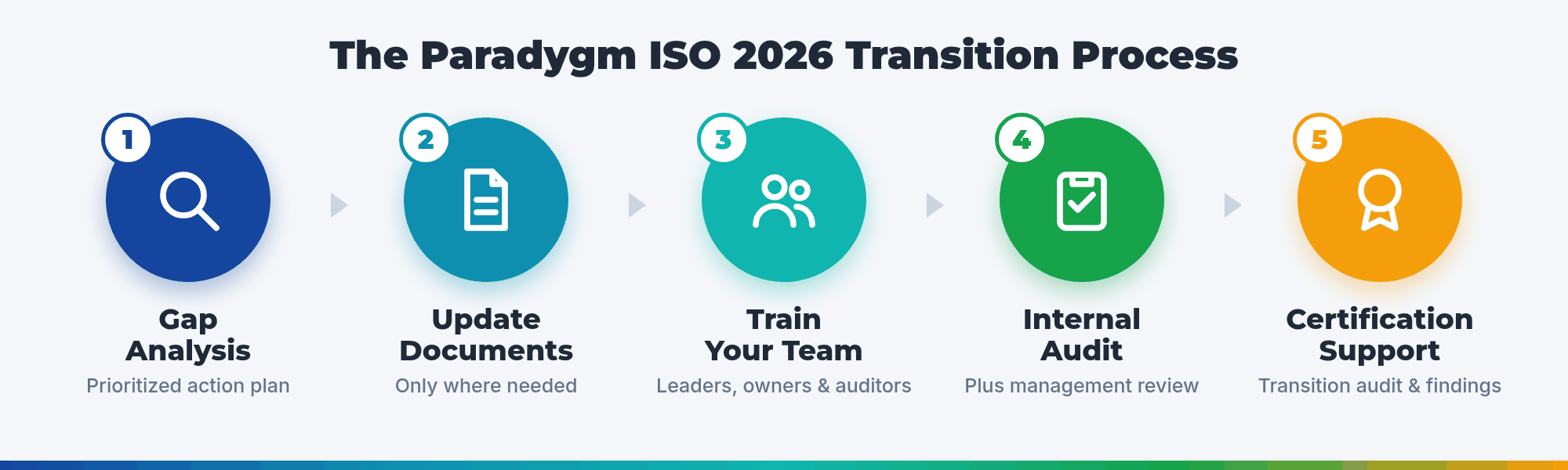
Our five-step path to a successful ISO 9001:2026 transition audit.
Paradygm’s transition approach mirrors how successful organizations move between editions—without reinventing a working QMS.
1. Understand the changes
Review ISO 9001:2026 against your current system. Identify which clause refinements actually affect your context, leadership practices, risk/opportunity methods, change control, and awareness training.
2. Gap analysis
We assess your existing QMS against ISO 9001:2026 requirements and produce a prioritized action plan: what already conforms, what needs update, and what can be simplified.
3. Update documentation and processes
Revise the quality manual (or equivalent), procedures, and work instructions only where needed. Strengthen leadership accountability language, risk/opportunity methods, change management, and climate/context considerations as they apply to your organization.
4. Train your people
Leaders, process owners, and internal auditors need to understand what changed and why. Paradygm delivers on-site and remote training.
5. Internal audit and management review
Confirm the updated system works in practice before the certification body arrives. We support internal auditor coaching, pre-audits, and management review facilitation.
6. Certification body transition support
We help you coordinate with your registrar (or select one), prepare for the transition audit, and close findings efficiently—so your certificate moves to ISO 9001:2026 on schedule.
Fixed-cost consulting fees are available for defined scopes. Guaranteed certification support applies when the agreed scope is followed and the organization implements required actions in good faith before the certification audit.
Integrated management systems (9001 + 14001 + 45001)
Many Paradygm clients run quality, environmental, and occupational health & safety systems together. Because ISO 9001:2026 and ISO 14001:2026 both align to the Harmonized Structure—and both reinforce leadership, context, risk/opportunity thinking, and change management—transitioning standards together is often more efficient than treating them as separate projects.
We can:
Run a combined gap analysis across ISO 9001, ISO 14001, and ISO 45001
Align shared processes (document control, internal audit, management review, competence, nonconformity/corrective action)
Sequence training and internal audits once, not three times
Coordinate with your certification body for combined or consecutive transition audits
If you also hold AS9100-family or R2 certifications, we map interfaces so quality and environmental updates do not create conflicts in aerospace or sustainable electronics programs. For aerospace standards evolution, see our dedicated resource hub at ia9100.co.
Why Paradygm for your ISO 9001:2026 transition
25+ years helping organizations achieve and maintain ISO-based certification
Canada and United States coverage — Thornhill, Ontario and Coral Springs, Florida, with remote and on-site support
Multi-standard depth — ISO 9001, ISO 14001, ISO 45001, AS9100 family, R2, and related standards
Integrated management system experience for organizations that do not want three disconnected binders
Practical training — on-site coaching and practical training for your team
Clear commercial model — fixed-cost consulting fees and guaranteed certification language paired with defined scope and client cooperation
Hundreds of successful certifications, including first-attempt certification outcomes for many clients
We are consultants and auditors—not a substitute for your accredited certification body. Our role is to get your system ready so the registrar’s transition audit succeeds.
Frequently asked questions — ISO 9001:2026 transition
When was ISO 9001:2026 published?
ISO published ISO 9001:2026 on 16 September 2026. It is now the current edition of the standard and replaces ISO 9001:2015.
What is the ISO 9001:2026 transition deadline?
For organizations with accredited ISO 9001:2015 certificates, Global ACI’s transition requirements set 30 September 2029 as the date by which transition to ISO 9001:2026 must be completed. From 31 March 2028, new and initial accredited certifications may only be issued to the 2026 edition.
Do I need to rebuild my entire quality management system?
No. ISO and major registrars describe the changes as moderate. Keep what works. Use a gap analysis to update leadership, culture/ethics awareness, risk and opportunity methods, change management, context/climate considerations, and any documentation that no longer matches the clarified intent.
Is climate change still relevant under ISO 9001:2026?
Yes. Climate-related considerations introduced in the 2024 amendment to ISO 9001:2015 are carried into ISO 9001:2026. Organizations should continue to determine whether climate change is a relevant issue for their context and interested parties.
Does ISO 9001:2026 require AI or digital transformation?
No. The standard does not mandate artificial intelligence or specific software. Where digital tools support the QMS, organizations still need reliable information, clear accountability for decisions, and controlled documented information.
Can I transition during my next surveillance audit?
Often yes. Global ACI notes that transition may occur during a scheduled surveillance or recertification audit, or via a separate transition audit. Confirm the approach and audit-day expectations with your certification body early.
We are in Ontario / Canada — can Paradygm help?
Yes. Paradygm supports organizations across Canada from our Thornhill, Ontario base, and works with multi-site Canadian companies seeking an ISO 9001 consultant who understands both local operations and accredited certification practice.
We are in Florida / the United States — can Paradygm help?
Yes. Our Coral Springs, Florida office supports US clients seeking ISO 9001:2026 transition consulting, including manufacturers, distributors, and service organizations preparing for registrar audits.
Can we transition ISO 9001 and ISO 14001 together?
Yes—and it is often smarter. Shared Harmonized Structure clauses and overlapping leadership/context/risk themes allow a combined project plan, shared training, and coordinated audits. Ask us about an IMS transition package.
How long does an ISO 9001:2026 transition project take?
It depends on system maturity, number of sites, and how much documentation needs update. Many organizations complete focused transitions over a few months once the gap analysis is done; complex multi-site systems take longer. We provide a schedule with the proposal.
What does “guaranteed certification” mean at Paradygm?
When you engage Paradygm under an agreed scope and implement the actions we identify, we stand behind our consulting support through certification. Guarantee terms are defined in the proposal and depend on client cooperation, timely implementation, and scope boundaries. Your accredited certification body remains the independent issuer of the certificate.
How do I get started?
Call 1-855-702-9001, email info@paradygm.co, or request a quote through paradygm.co. We will schedule a discovery call, outline a gap analysis, and propose a fixed-cost path to ISO 9001:2026.
Ready to plan your ISO 9001:2026 transition?
Do not wait until 2029 to discover documentation gaps, auditor backlog, or training shortfalls. Start with a clear gap analysis and a realistic schedule aligned to your next surveillance or recertification window.
Paradygm Consulting
ISO 9001:2026 transition consulting for Canada and the United States
Phone: 1-855-702-9001
Email: info@paradygm.co
Web: www.paradygm.co · Consulting services · Request a quote
Sources for standard status and transition dates: ISO publication announcements and Global ACI transition requirements for ISO 9001:2026. Always confirm final audit timing with your accredited certification body.