
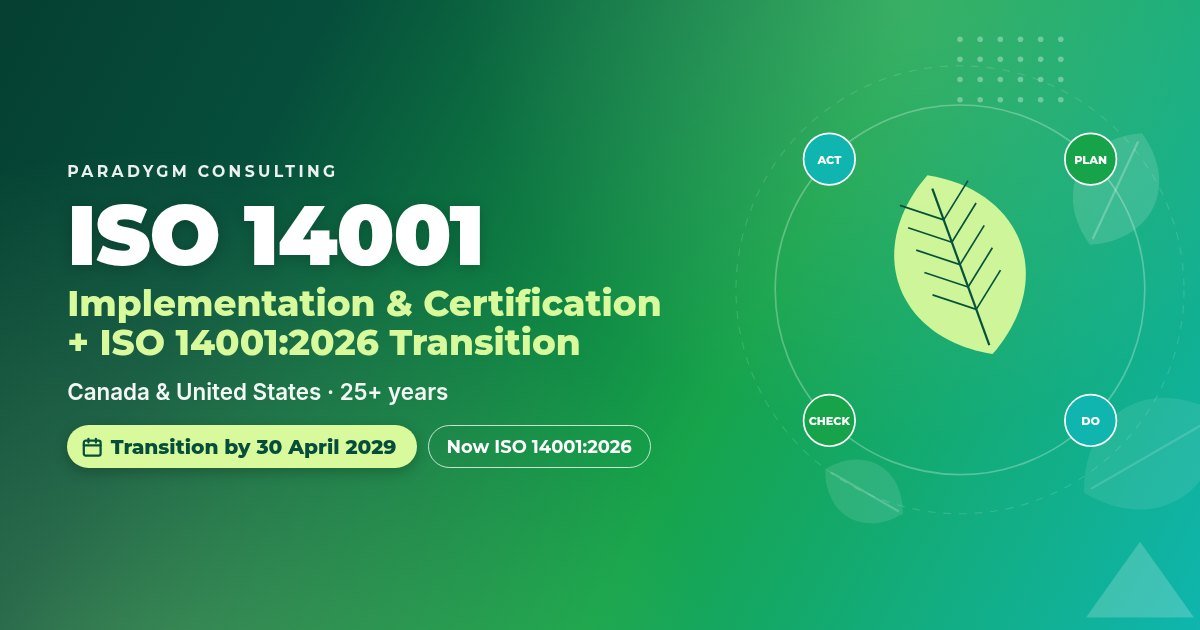
ISO 14001:2026 was published on April 15, 2026. If you hold an ISO 14001:2015 certificate, it has to move to the new edition by April 2029. If you're certifying for the first time, you'll be building to the 2026 edition. Paradygm helps organizations across Canada and the United States do both, without rebuilding what already works.
- 25+ years of experience
- Over 200 clients
- 100% compliance track record
- Guaranteed Certification within the first attempt
- Thornhill, ON · Coral Springs, FL
Your transition at a glance
- Apr 15, 2026ISO 14001:2026 published.
- By Oct 31, 2026Accreditation bodies ready to assess the 2026 edition.
- By Apr 30, 2027Certification bodies' own transitions decided. Your registrar can issue accredited 2026 certificates only after this step.
- From Oct 31, 2027New and first-time certificates issued to the 2026 edition only.
- By April 2029All 2015 certificates must be transitioned: US — April 30, 2029 (Global ACI / ANAB); Canada — April 15, 2029 (SCC).
Your certification body sets the exact date for your certificate. Ask it now which audit will be your transition audit. We recommend finishing early, well before the last months, when registrar calendars fill up. A 2015-to-2026 transition typically takes about 2 months.
What's new in ISO 14001:2026
The 2026 edition refines the 2015 framework rather than replacing it. Most well-run systems need targeted updates, not a rebuild. These are the areas certification bodies are focusing on (our paraphrase, by clause):
- Clause 4.1, 4.2 Wider environmental context Climate change stays in, and you now also consider conditions such as pollution, resource availability and biodiversity, in proportion to your operations.
- Clause 4.3, 6.1.2 Life cycle thinking from the start A life cycle perspective now shapes your EMS scope as well as your aspects and controls.
- Clause 5.1 Leadership that reaches every role Top management is expected to support everyone with an EMS role, not just managers.
- Clause 6.1 Clearer risk and opportunity planning The section is reorganized, so registers and procedures should be re-mapped.
- Clause 6.3 New: planning of changes Changes to equipment, processes, suppliers, sites, laws or ownership need to be planned so environmental controls keep working.
- Clause 6.1.2, 8.2 Potential emergencies Look at all potential emergency situations, not only the ones you consider likely.
- Clause 8.1 External providers Control now covers externally provided processes, products and services, using a risk-based approach.
- Clause 9.2, 9.3 Sharper audits and reviews Each internal audit needs defined objectives, and management review inputs and results are more clearly structured.
The 2024 climate amendment is now part of the standard, and Annex A guidance is greatly expanded. Clause summaries are Paradygm's paraphrase, not the text of ISO 14001.
2015 vs 2026: what you'll need to update
| Area | In your 2015 system | What to update for 2026 |
|---|---|---|
| Context | Climate considered (2024 amendment) | Add pollution, resources, biodiversity where relevant |
| Scope | Site boundaries | Consider upstream/downstream life cycle stages |
| Change management | Often informal or only in ISO 9001 | Documented, planned approach for EMS changes |
| Suppliers & contractors | Outsourced processes | All relevant externally provided processes, products and services |
| Emergencies | Reasonably foreseeable | All potential emergency situations |
| Internal audit | Scope and criteria | Plus defined objectives for each audit |
| Management review | One set of minutes | Inputs and results clearly separated |
How Paradygm helps
- 2026 transition gap assessment We review your EMS against the 2026 edition, clause by clause, and give you a prioritized action list, so you know the size of the job before you commit. Also certified to ISO 9001? Choose our combined ISO 9001:2026 + ISO 14001:2026 transition gap assessment: one review, one action plan for both.
- Implementation and documentation updates Context, aspects, legal (compliance-obligation) registers built for your sites, change planning, supplier controls and management review templates, kept lean and written in Harmonized Structure terms. First-time clients get a complete EMS built to the 2026 edition.
- Internal audits, including integrated audits An internal audit against the 2026 edition before your registrar arrives. Already running ISO 9001 or ISO 45001? One combined audit covers all of them. See Integrated Internal Audits.
- Training Leadership briefings and staff awareness on the 2026 changes, plus general internal auditor training for your team. Ask about training.
- Certification readiness Help choosing or scheduling your accredited certification body, readiness checks, and support during the audit. Follow-up on corrective actions after the audit may be quoted separately depending on scope.
Every project starts with a quote, with no hidden costs. Your certification body remains the independent issuer of the certificate.
Working with us, step by step
Here is what a typical project looks like, from the first call to your certificate.
- Scoping callWe confirm your sites, activities and goal (first-time certification or a 2015-to-2026 transition), then send a quote with no hidden costs.
- On-site gap assessmentWe visit your facility, review your current practices, permits and records, and agree the action plan with you.
- Implementation and documentationWe build a lean EMS on what you already do, including your environmental aspects, legal register, objectives and operational controls.
- Internal audit and management reviewWe carry out the internal audit, or coach your team through it, and help you prepare the management review.
- Certification audit supportWe support you through the Stage 1 and Stage 2 audits by your accredited certification body.

Who should act now
- Certified to ISO 14001:2015 (with or without the 2024 climate amendment)
- Planning first-time certification in 2027 or later
- Running ISO 9001, which moved to its 2026 edition on Sept 16, 2026 (ANAB transition deadline Sept 30, 2029), and wanting one plan for both
- Multi-site operations in Canada, the US or both
- Recyclers, manufacturers and logistics operations whose customers ask for supplier environmental controls
One system: ISO 14001, ISO 9001 and ISO 45001
ISO 14001:2026 and ISO 9001:2026 share ISO's Harmonized Structure, and ISO 45001 is being revised on the same structure (new edition expected in 2027). That means context, leadership, risk, change planning, competence, documents, internal audit, management review and corrective action can be run once for all three. Our combined ISO 9001:2026 + ISO 14001:2026 transition gap assessment and integrated internal audits let you update shared processes once.
Related: ISO 45001 · ISO 9001 · Integrated Internal Audits

ISO 14001 and legal compliance
ISO 14001 requires you to know your compliance obligations and evaluate whether you meet them (clauses 6.1.3 and 9.1.2). Paradygm builds legal (compliance-obligation) registers that list what applies to each site, who owns it and how compliance is shown. Certification shows you have a working system; it isn't a regulatory inspection. For a detailed check of your sites against US EPA and OSHA rules, or Canadian federal and provincial requirements, see Regulatory Compliance Audits.
Legal registers for Canadian sites
For a site in Canada, the register usually starts with federal law, for example:
- The Canadian Environmental Protection Act, 1999 and the regulations under it that apply to your substances and activities.
- The Transportation of Dangerous Goods Regulations, if you ship or receive dangerous goods, including hazardous waste.
Provincial and territorial environmental laws and permits vary from province to province. They commonly cover approvals for air emissions and wastewater, water use, hazardous waste and spill reporting. We confirm what applies to each site during scoping, so a multi-site register stays consistent across provinces, and each entry links to the controls and records that show compliance.
Why Paradygm
- 25+ years of ISO consulting, auditing and training
- Over 200 clients across Canada and the United States
- A track record of 100% compliance
- Guaranteed Certification within the first attempt
- Offices in Thornhill, Ontario and Coral Springs, Florida
- Quality, environmental and health & safety expertise: ISO 9001, ISO 14001, ISO 45001, the AS9100 family and R2
- No hidden costs
What is ISO 14001?
ISO 14001 sets out the requirements for an environmental management system (EMS): the policies, processes, responsibilities and records an organization uses to manage its environmental aspects, meet its compliance obligations and improve its environmental performance. It applies to any organization, of any size, in any sector, and it is the only standard in the ISO 14000 family that an organization can be certified to.
First published in 1996, revised in 2004 and 2015, amended for climate in 2024, and now in its 2026 fourth edition.
Benefits of ISO 14001 certification
- Stay in compliance with the environmental laws, permits and other obligations that apply to you
- Cut costs through more efficient use of energy, water and raw materials, and less waste
- Win and keep customers who require a certified EMS from their suppliers
- Reduce environmental risk and liability with planned controls and emergency response
- Build stakeholder trust with third-party-verified evidence
- Integrate with ISO 9001 and ISO 45001 on one common management system structure
Clauses 4–10 at a glance
ISO 14001 follows ISO's Harmonized Structure. The auditable requirements are in Clauses 4–10, organized around the Plan-Do-Check-Act cycle. The one-line summaries below are our paraphrase, not the text of the standard.

- Clause 4, ContextInternal and external issues, interested parties, compliance obligations and the EMS scope.
- Clause 5, LeadershipTop management accountability, the environmental policy, roles and responsibilities.
- Clause 6, PlanningRisks and opportunities, significant aspects, compliance obligations, objectives and planning of changes.
- Clause 7, SupportResources, competence, awareness, communication and documented information.
- Clause 8, OperationOperational control, externally provided processes, life cycle stages and emergency preparedness.
- Clause 9, Performance evaluationMonitoring, evaluation of compliance, internal audit and management review.
- Clause 10, ImprovementNonconformity, corrective action and continual improvement.
The certification process
Gap assessment → implementation → internal audit and management review → Stage 1 audit → Stage 2 audit → surveillance. Your accredited certification body carries out the Stage 1 and Stage 2 audits and issues the certificate, which is valid for three years with surveillance audits at least annually. First-time certification often takes about 6 to 12 months. A 2015-to-2026 transition typically takes about 2 months.
Related standards
- ISO 14004: general guidance on implementing an EMS
- ISO 14031: environmental performance evaluation
- ISO 14064 series: greenhouse gas quantification and verification
- ISO 14040 / 14044: life cycle assessment
- ISO 19011: general guidance for auditing management systems
You certify to ISO 14001 only; the others are guidance you can draw on.
Frequently asked questions
- 1. What changed in ISO 14001:2026? It's a refinement of the 2015 edition. The main updates are a wider context analysis (pollution, resources and biodiversity alongside climate), stronger life cycle thinking, a new requirement to plan changes (6.3), broader control of external providers (8.1), defined objectives for internal audits and a restructured management review. The 2024 climate amendment is built in.
- 2. When do we have to transition, and is our 2015 certificate still valid? Global ACI, whose rules accredited certification bodies follow, set the end of the transition at April 30, 2029, and ANAB in the US uses the same date. In Canada, SCC lists April 15, 2029. Your 2015 certificate stays valid until then; after that, accredited 2015 certificates are no longer valid. Your certification body confirms the date for your certificate, and we recommend finishing early.
- 3. What does "Guaranteed Certification within the first attempt" mean? We offer Guaranteed Certification within the first attempt. Your accredited certification body issues the certificate independently.
- 4. We aren't certified yet. Should we use 2015 or 2026? Build to 2026. From October 31, 2027, new certificates can only be issued to the 2026 edition, and a 2015 certificate would need a transition audit soon after anyway. Ask your registrar when it can issue accredited 2026 certificates.
- 5. Can we transition at our next surveillance audit? Usually, yes. The transition audit can be combined with a surveillance or recertification audit, or held as a separate audit. Your certification body decides whether extra audit time is needed.
- 6. Do we have to measure biodiversity? No. You need to consider biodiversity and other environmental conditions when you analyse your context, in proportion to your activities. If one isn't relevant, record why.
- 7. What does planning of changes (6.3) mean in practice? Before you change equipment, processes, suppliers, sites or ownership, or respond to new laws, you assess the environmental effect, plan the change and check that controls still work afterward. If you run ISO 9001, you can usually extend the change process you already have.
- 8. Can we transition ISO 9001:2026 and ISO 14001:2026 together? Yes. Both share the Harmonized Structure, so one combined gap assessment and one integrated internal audit can cover both. ISO 9001:2026 was published Sept 16, 2026 and its transition ends Sept 30, 2029 (ANAB). See the combined transition gap assessment.
- 9. Does ISO 14001 certification prove we comply with environmental law? No. It shows you have a system to identify and meet your compliance obligations. For a site-by-site legal check, see our Regulatory Compliance Audits.
- 10. How long does it take and what does it cost? It depends on your size, sites and existing system. First-time certification often takes about 6 to 12 months. A 2015-to-2026 transition typically takes about 2 months. We provide a quote with no hidden costs after a short scoping call.
- 11. Do you work on site at our facilities? Yes. Gap assessments, implementation support and internal audits are done on site at your facilities across Canada, and we also work on site across the US. Training can be delivered on-site or remotely.
- 12. How do we choose a certification body (registrar)? Choose one whose accreditation covers ISO 14001 and your type of operations, such as a certification body accredited by the Standards Council of Canada (SCC) or by ANAB in the US. Check that it can audit all of your sites and schedule your Stage 1 and Stage 2 audits before your customer or transition deadline. We help you compare registrars and prepare your team for their audits.
Why clients choose Paradygm
Certification coaching from gap assessment through your certification audit, for organizations across Canada and on-site in all US states.
- 25+years of experience
Guaranteed Certification within the first attempt.
Request a quoteRelated
- ISO 9001 + 14001:2026 Transition Gap Assessment
- ISO 9001 · ISO 45001 · Internal Auditing
- Regulatory Compliance Audits · Training hub
- All solutions · Request a quote
Sources: ISO; Global Accreditation Cooperation; ANAB; Standards Council of Canada. Clause summaries are Paradygm's paraphrase, not the text of ISO 14001. Confirm audit timing with your accredited certification body. This page is educational consulting guidance, not legal advice.